Types of stablecoins
Published: 23 Jan 2026
Did you know that the total market value of stablecoins has grown to over $150 billion in 2026? Stablecoins are a type of cryptocurrency designed to maintain stable value. Unlike other cryptocurrencies, their prices do not change drastically every day. This makes them useful for trading, payments, and holding value without the risk of big losses. Learning about the types of stablecoins helps beginners understand how they work in the crypto world. In this article, we will explain all the major types, their features, pros and cons, and examples.
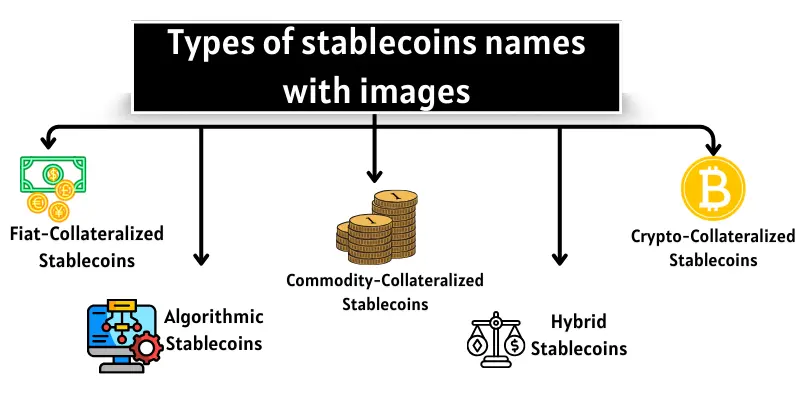
Different types of stablecoins
Stablecoins are designed to maintain a stable value. They are usually pegged to assets like fiat currency, crypto, or commodities.
- Fiat-Collateralized Stablecoins
- Crypto-Collateralized Stablecoins
- Algorithmic (Non-Collateralized) Stablecoins
- Commodity-Collateralized Stablecoins
- Hybrid Stablecoins
1. Fiat-Collateralized Stablecoins
Fiat-collateralized stablecoins are backed by real-world money like US dollars or euros. This means that for every stablecoin, there is an equal amount of fiat money kept in a bank or reserve. These coins are very popular because they stay close to a fixed value.
| Pros |
|---|
|
| Cons |
|---|
|
Examples:
- Tether (USDT)
- USD Coin (USDC)
- Binance USD (BUSD)
2. Crypto-Collateralized Stablecoins
Crypto-collateralized stablecoins are backed by other cryptocurrencies instead of real-world money. People lock crypto like Ethereum in a smart contract to create these stablecoins. They keep their value stable using extra collateral.
| Benefits |
|---|
|
| Drawbacks |
|---|
|
Examples:
- DAI
- sUSD
- MUSD
3. Algorithmic (Non-Collateralized) Stablecoins
Algorithmic stablecoins do not use real money or crypto as collateral. Instead, they use smart contracts and algorithms to keep their value stable. The system automatically adds or removes coins to control the price.
| Advantages: |
|---|
|
| Risk |
|---|
|
Examples:
- TerraUSD (UST)
- FEI
- Ampleforth (AMPL)
4. Commodity-Collateralized Stablecoins
Commodity-collateralized stablecoins are backed by real-world assets like gold, silver, or oil. This means each stablecoin represents a certain amount of the commodity. People use them to invest in crypto while keeping value tied to physical assets.
| Pros |
|---|
|
| Cons |
|---|
|
Examples:
- PAX Gold (PAXG)
- Tether Gold (XAUT)
- Digix Gold Token (DGX)
5. Hybrid Stablecoins
Hybrid stablecoins combine features of collateralized and algorithmic stablecoins. They use both assets and algorithms to maintain stable value. This system aims to balance stability and decentralization.
| Pros |
|---|
|
| Cons |
|---|
|
Examples:
- Frax (FRAX)
- Neutrino USD (USDN)
Conclusion
So, guys, it’s time to wrap up! We have covered Types of Stablecoins in detail. This guide explained each type, its features, pros, cons, and examples. If you found this guide helpful, share it with your friends and explore our other crypto guides to learn more.
FAQs about types of stablecoins
Hybrid stablecoins combine collateralized and algorithmic systems to stay stable. They use both assets and algorithms for security. Frax (FRAX) is a popular example.
No, stablecoins reduce volatility but are not fully risk-free. Some types depend on banks, algorithms, or commodity markets. Understanding each type helps to know potential risks.
You can read educational guides like this one to understand stablecoins better. Comparing the different types helps in learning their features. Check more crypto guides to get a full picture of the market.

- Be Respectful
- Stay Relevant
- Stay Positive
- True Feedback
- Encourage Discussion
- Avoid Spamming
- No Fake News
- Don't Copy-Paste
- No Personal Attacks
- Be Respectful
- Stay Relevant
- Stay Positive
- True Feedback
- Encourage Discussion
- Avoid Spamming
- No Fake News
- Don't Copy-Paste
- No Personal Attacks
