Types of cryptocurrency – A Complete Beginners Guide
Published: 2 Jan 2026
Ever wondered why there are so many digital coins like Bitcoin, Ethereum, and Dogecoin? With so many options, it’s easy to feel lost. Learning about the different types of cryptocurrency can help you understand their uses and decide which ones suit your needs.
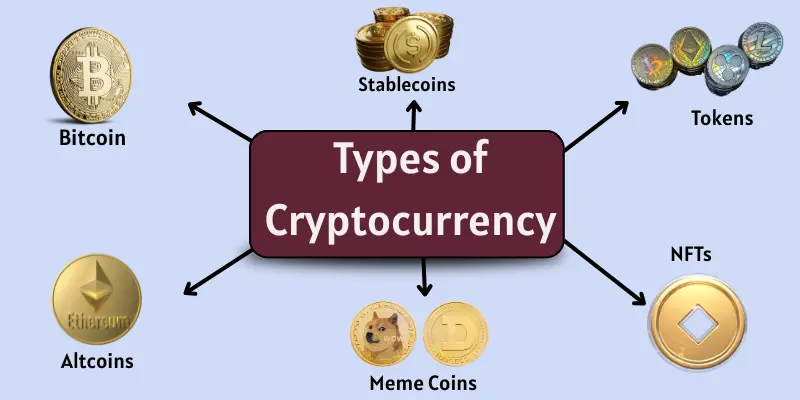
What are types of cryptocurrency?
Cryptocurrency is digital money that exists only online. There are many different kinds, each serving a unique purpose. Understanding the types of cryptocurrency is the first step to exploring this digital world.
Types of Cryptocurrency:
- Bitcoin
- Altcoins
- Stablecoins
- Tokens
- Meme Coins
- Privacy Coins
- Payment Cryptocurrencies
- NFTs
- Central Bank Digital Currencies (CBDCs)
- Layer 2 / Sidechain Tokens
- Hybrid / Multi-purpose Coins
1. Bitcoin (BTC)
Bitcoin is the first cryptocurrency. It was created in 2009 by Satoshi Nakamoto. People use Bitcoin to send money online safely. It works without a bank or government. Bitcoin is like digital gold because many people save it.
There are different types of Bitcoin:
- Bitcoin Core (BTC): The main and original version.
- Bitcoin Cash (BCH): Made for faster transactions.
- Bitcoin SV (BSV): Focused on stability and big blocks.
- Wrapped Bitcoin (WBTC): Used on other blockchains.
- Bitcoin Lightning Network: Made for very fast small payments
2. Altcoins
Altcoins are all cryptocurrencies other than Bitcoin. They are made to solve problems that Bitcoin cannot. Some altcoins help run smart contracts. Others focus on faster payments or lower fees. Altcoins give people more choices in digital money.
Different types of Altcoins:
- Ethereum (ETH): Runs smart contracts and apps
- Litecoin (LTC): Makes faster payments than Bitcoin
- Ripple (XRP): Helps banks send money worldwide
- Cardano (ADA): Focuses on energy-efficient transactions
- Polkadot (DOT): Connects multiple blockchains together
3. Stablecoins
Stablecoins are cryptocurrencies made to keep their value stable. They are usually linked to real-world money like the US dollar. People use stablecoins to avoid big price changes. They are safe for trading and saving. Stablecoins help beginners feel secure in digital money.
Different example of Stablecoins:
- Tether (USDT): Pegged to the US dollar for stability
- USD Coin (USDC): Backed by real money in banks
- Dai (DAI): A stablecoin that works without a bank
- TrueUSD (TUSD): Fully backed by dollars in a safe account
- Paxos Standard (PAX): Keeps value equal to one US dollar
4. Tokens
Tokens are cryptocurrencies built on other blockchains. They are not independent coins. People use tokens for various purposes, such as voting, accessing services, or trading. Tokens make blockchain projects more useful. They give users extra features beyond normal money.
Different types of Tokens:
- Utility Tokens: Let users access products or services
- Governance Tokens: Allow holders to vote on project decisions
- Security Tokens: Represent ownership in real-world assets
- Reward Tokens: Given to users as incentives or rewards
- Stable Tokens: Tokens that keep their value steady for trading
5. Meme Coins
Meme coins are cryptocurrencies made for fun or trends. They often start as jokes but can become popular. People buy them because they go viral on social media. Meme coins are easy to trade and can rise in value quickly. They make cryptocurrency exciting for beginners.
Different types of Meme Coins:
- Dogecoin (DOGE): Started as a joke but became very popular
- Shiba Inu (SHIB): Inspired by the Dogecoin trend
- Floki Inu (FLOKI): Named after a famous meme character
- SafeMoon (SAFEMOON): Gained attention for viral marketing
- Pepe Coin (PEPE): Based on internet memes and communities
6. Privacy Coins
Privacy coins are cryptocurrencies that keep transactions secret. They hide sender, receiver, and amount details. People use them when they want full privacy. These coins make trading more secure and private. Privacy coins are important for users who value confidentiality.
Here are the different top privacy coins:
- Monero (XMR): Focuses on complete anonymity
- ZCash (ZEC): Offers optional private transactions
- Dash (DASH): Provides fast and private payments
- Verge (XVG): Uses multiple privacy technologies
- Horizen (ZEN): Secures data and transactions on blockchain
7. Payment Cryptocurrencies
Payment cryptocurrencies are made mainly for sending and receiving money. They make transactions faster and cheaper than banks. People use them to pay for goods or services online. These coins focus on convenience and speed. Payment cryptocurrencies help businesses and users easily transfer money.
Different types of Payment Cryptocurrencies:
- Bitcoin Cash (BCH): Made for faster payments than Bitcoin
- Litecoin (LTC): Offers low-fee and quick transactions
- Dash (DASH): Designed for instant payments
- Stellar (XLM): Helps cross-border money transfers
- Nano (NANO): Focuses on feeless and instant transfers
8. NFTs (Non-Fungible Tokens)
NFTs are special digital tokens that are one-of-a-kind. Each NFT is unique and cannot be exchanged for another equally. People use NFTs for digital art, collectibles, and games. NFTs show proof of ownership on the blockchain. They make digital items valuable and tradable.
Different types of NFTs:
- Art NFTs: Represent digital artworks
- Collectible NFTs: Digital cards, figures, or items to collect
- Gaming NFTs: Items used in video games
- Music NFTs: Represent songs or albums
- Virtual Real Estate NFTs: Digital land or property in virtual worlds
9. Central Bank Digital Currencies (CBDCs)
CBDCs are digital money issued by governments. They work like regular money but exist only online. People use them to pay and receive money safely. CBDCs are backed by banks and governments. They make digital payments trusted and secure.
Different types of CBDCs:
- Digital Yuan (China): Government-backed digital money in China
- Sand Dollar (Bahamas): Digital currency for safe island payments
- e-Krona (Sweden): Sweden’s digital form of money
- Digital Euro (Europe): European digital currency for online use
- Digital Dollar (USA – proposed): Planned US digital currency
10. Layer 2 / Sidechain Tokens
Layer 2 tokens work on top of existing blockchains. They make transactions faster and cheaper. People use them to reduce congestion on main blockchains. These tokens help blockchain networks handle more users. Layer 2 tokens make crypto more efficient.
Different types of Layer 2 / Sidechain Tokens:
- Polygon (MATIC): Speeds up Ethereum transactions
- Loopring (LRC): Helps Ethereum handle more trades
- Optimism (OP): Boosts blockchain performance
- Arbitrum (ARB): Makes transactions faster and cheaper
- xDai (STAKE): Focuses on low-cost payments
11. Hybrid / Multi-purpose Coins
Hybrid coins are cryptocurrencies that serve many purposes. They can be used for payments, smart contracts, and more. People use them because they combine features from different types. Hybrid coins make blockchain projects flexible and useful. They help users do more with one coin.
Different types of Hybrid / Multi-purpose Coins:
- Solana (SOL): Fast and supports multiple apps
- Avalanche (AVAX): Handles smart contracts and payments
- NEO (NEO): Works for digital assets and contracts
- Qtum (QTUM): Combines smart contracts with payments
- Icon (ICX): Connects different blockchain networks
Conclusion
Now, everyone, let’s bring this guide to an end! In this article, we’ve covered types of cryptocurrency in depth. My recommendation is to start with a few well-known and stable cryptocurrencies before trying the more complex ones. Take your time to learn and understand each type. Start exploring today and choose the coins that fit your goals!
FAQs about types of cryptocurrency
Here are the most asked questions about crypto types
Bitcoin is the first cryptocurrency and very popular. Altcoins are all other coins besides Bitcoin. Altcoins often try to solve problems that Bitcoin cannot.
Stablecoins are digital coins that keep their value steady. People use them to avoid big price changes. They are safe for trading and saving.
Tokens are coins built on existing blockchains. They can be used for voting, rewards, or accessing services. Tokens are not independent like Bitcoin.
NFTs are special digital tokens. Each one is unique and cannot be exchanged equally. People use NFTs for digital art, collectibles, and gaming items.
Privacy coins hide transaction details. They protect those who send and receive money. People use them for secure and private trading.
CBDCs are digital money issued by governments. They work like regular money but only exist online. They are trusted and backed by banks.

- Be Respectful
- Stay Relevant
- Stay Positive
- True Feedback
- Encourage Discussion
- Avoid Spamming
- No Fake News
- Don't Copy-Paste
- No Personal Attacks
- Be Respectful
- Stay Relevant
- Stay Positive
- True Feedback
- Encourage Discussion
- Avoid Spamming
- No Fake News
- Don't Copy-Paste
- No Personal Attacks
