Advantages and disadvantages of cryptocurrency
Published: 6 Jan 2026
Are cryptocurrencies really safe to use, or are they just a risky gamble? Many beginners are confused about the real advantages and disadvantages of cryptocurrency, making it important to know both sides before investing or spending. Let’s learn in detail.
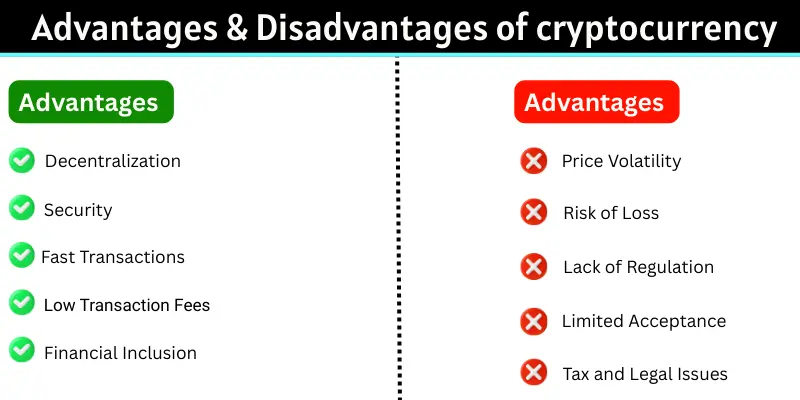
What are the 10 Advantages and disadvantages of cryptocurrency?
Advantages are the good points of cryptocurrency, like sending money fast or earning a profit. Disadvantages are the drawbacks, such as losing money or falling victim to scams. Now, let’s explore the advantages and disadvantages of cryptocurrency in detail.
10 Advantages of cryptocurrency
Cryptocurrency has many benefits that make it popular among investors and users. It offers new ways to send money, invest, and use digital currency securely. Here are 10 advantages of cryptocurrency

10 Advantages of Cryptocurrency:
- Decentralization
- Security
- Fast Transactions
- Low Transaction Fees
- Transparency
- Financial Inclusion
- Potential for High Returns
- Ownership Control
- Global Accessibility
- Supports Innovation and Technology
1. Decentralization
Decentralization means no single person or government controls cryptocurrency. People can send and receive money directly without banks or middlemen. This makes transactions faster and more free. Users have more power and control over their own money.
2. Security
Cryptocurrency is very secure because it uses special technology called blockchain. Every transaction is recorded and cannot be changed. This helps protect your money from hackers and fraud. If you want to learn more, visit the detailed guide on securing cryptocurrency.
3. Fast Transactions
Cryptocurrency allows people to send money very quickly. Transactions can occur in minutes, even across international borders. You do not have to wait for banks to open or process payments.
4. Low Transaction Fees
Cryptocurrency usually has very low fees for sending money. You do not need to pay high charges like banks or money transfer services. This makes it cheaper to use for both small and big payments.
5. Transparency
Cryptocurrency keeps all transactions open and recorded on the blockchain. Everyone can see the records, but personal information stays safe. This makes the system honest and hard to cheat.
6. Financial Inclusion
Cryptocurrency allows people who do not have bank accounts to use money online. Anyone with internet access can send, receive, and store digital currency. This helps more people join the financial system easily.
7. Potential for High Returns
Cryptocurrency can increase in value very quickly. People can earn profits by buying at a low price and selling at a higher price. This makes it attractive for investors.
8. Ownership Control
With cryptocurrency, you fully own your money. No bank or company can take it from you. You can spend or send it whenever you want.
9. Global Accessibility
Cryptocurrency can be used by anyone, anywhere in the world. You only need internet access. It makes it easy to send and receive money across countries.
10. Supports Innovation and Technology
Cryptocurrency encourages new technology like blockchain and smart contracts. It helps create new apps and digital services. It brings new ways to use money online.
10 Disadvantages of cryptocurrency
Cryptocurrency also has risks and challenges that every user should be aware of. Understanding these disadvantages helps beginners use it safely and make better decisions. Here are 10 disadvantages of cryptocurrency

- Price Volatility
- Risk of Loss
- Lack of Regulation
- Limited Acceptance
- Complexity for Beginners
- Environmental Impact
- Fraud and Scams
- Irreversible Transactions
- Tax and Legal Issues
- Market Manipulation
1. Price Volatility
Cryptocurrency prices can change very quickly. This means the value of your money can go up or down in a short time. It can be risky for beginners who are not ready for sudden changes.
2. Risk of Loss
People can lose their cryptocurrency if they do not store it safely. Wallets can be hacked, or private keys can be lost. Once lost, the money cannot be recovered.
3. Lack of Regulation
Cryptocurrency is not controlled by any government or bank. This can lead to scams and fraud. Users do not have legal protection if something goes wrong.
4. Limited Acceptance
Not all shops or services accept cryptocurrency as payment. This makes it hard to use for daily purchases. You may still need traditional money for many things.
5. Complexity for Beginners
Cryptocurrency can be hard to understand for new users. Learning about wallets, keys, and transactions can be confusing. Beginners may make mistakes if they do not study properly.
6. Environmental Impact
Mining cryptocurrency uses a lot of electricity. This can harm the environment and increase energy costs. It is not eco-friendly compared to traditional money systems.
7. Fraud and Scams
Cryptocurrency is often targeted by scammers. Fake coins and dishonest platforms can trick people and steal their money. Users must be very careful when investing or trading.
8. Irreversible Transactions
Once a cryptocurrency transaction is completed, it cannot be reversed or undone. If you send money to the wrong address, you cannot get it back. This makes mistakes very costly for users.
9. Tax and Legal Issues
Cryptocurrency can be confusing when it comes to taxes and laws. Different countries have different rules, and beginners are likely to make mistakes. Not following the law can cause fines or legal problems.
10. Market Manipulation
The prices of cryptocurrency can be influenced by big investors or groups. It can make the market unfair for small users. Sudden price changes may happen because of manipulation, not real demand.
Conclusion
So guys, let’s bring this to a close! In this article, we’ve covered the 10 advantages and disadvantages of cryptocurrency in depth. My advice is to understand both the benefits and risks before using or investing in crypto. Take small steps and always protect your wallet. To start safely, begin learning and experimenting with small amounts today.
FAQs about the pros and cons of crypto
Yes, many countries require taxes on crypto profits. Rules vary, so check local regulations. Keep records of your transactions for safety.
Trading can be hard for beginners. You need to understand wallets, coins, and market trends. Start with small amounts to learn safely.
Transactions do not show personal information, but blockchain keeps public records. This makes it private but also transparent.
Not yet. Few shops and services accept it. It is still growing and cannot fully replace cash or cards.
Learning helps you avoid scams and mistakes. It also helps you use it safely and make smarter investments. Knowledge reduces risks.

- Be Respectful
- Stay Relevant
- Stay Positive
- True Feedback
- Encourage Discussion
- Avoid Spamming
- No Fake News
- Don't Copy-Paste
- No Personal Attacks
- Be Respectful
- Stay Relevant
- Stay Positive
- True Feedback
- Encourage Discussion
- Avoid Spamming
- No Fake News
- Don't Copy-Paste
- No Personal Attacks
