Decentralization in blockchain
Published: 17 Jan 2026
Imagine sending money online and worrying that a single bank or company might lose it or hack it. This fear disappears with blockchain decentralisation. Here, no single person or organization has full control. Many computers around the world share the power and check every transaction. This makes blockchain safe, fair, and open for everyone. In this guide, we will explain everything you need to know about what is decentralization in blockchain.

What is decentralization in blockchain?
Decentralization in blockchain means that no single person or organization controls the system. Instead, power is shared among many computers, called nodes, all over the world. Each node has a copy of the blockchain, and they work together to verify and record transactions. This makes the system secure, transparent, and trustworthy. In short, decentralization removes the need for a middleman and gives control to everyone in the network.
How Decentralization Works in Blockchain?
Decentralization in blockchain spreads control across many computers instead of one central authority. This system keeps transactions safe, transparent, and fair for everyone.
- Role of Nodes: Nodes are computers that check and validate every transaction. Each node has a full copy of the blockchain. They work together to prevent mistakes and fraud.
- Peer-to-Peer Network: Blockchain uses a peer-to-peer network, meaning nodes connect directly with each other. Transactions happen without a middleman. Data is shared quickly and equally across the network.
- No Central Authority: No single person, company, or bank controls the blockchain. All nodes must agree on transactions. This shared control builds trust and security for all users.
Key Features of Decentralization in Blockchain
Blockchain works differently from banks and companies. Its key features give power, security, and fairness to everyone.
Key Features:
- No Single Control: No person or company controls the blockchain alone.
- Distributed Network: Many nodes store and share data together.
- Transparency: All nodes can see and verify transactions.
- Security: Shared control reduces hacking risks.
- Trustless System: Users do not need to trust a middleman.
- Open Access: Anyone can join and participate in the network.
Types of Decentralization in Blockchain
Decentralization in blockchain happens in many ways. Each type shares control. It increases security and makes the system fair. Understanding these types helps beginners see how blockchain works clearly.
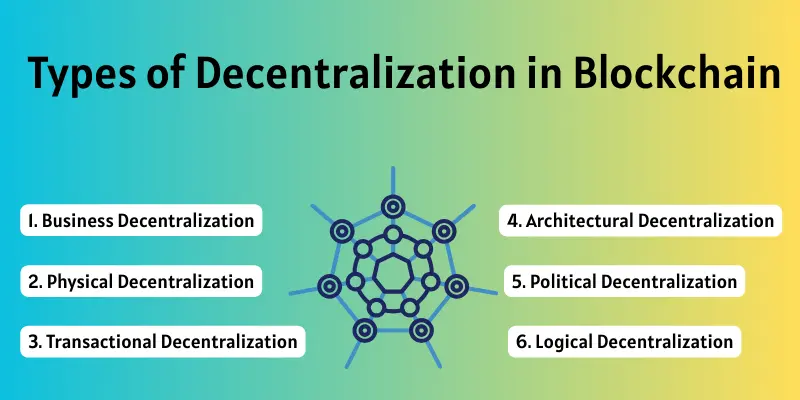
1. Business Decentralization
In this type, a single company controls the blockchain. Different businesses or organizations work together. They make decisions and manage operations as a group. This stops any one company from having too much power.
2. Physical Decentralization
Physical decentralization is about where computers or servers are located. Nodes are spread across different places. If one location stops working, the others continue. This makes the blockchain network strong and reliable.
3. Transactional Decentralization
Transactional decentralization ensures no single entity controls all transactions. Many nodes check every transaction. This keeps transactions secure and trustworthy. Everyone can rely on the network.
4. Architectural Decentralization
Architectural decentralization focuses on system structure. Many computers share and store data together. If one computer fails, the network still works. This keeps the blockchain safe and stable.
5. Political Decentralization
In political decentralization the community makes decisions. No single person or group has full control. Participants vote or agree on rules. This prevents misuse of power and keeps the system fair.
6. Logical Decentralization
Logical decentralization separates control from physical locations. Even if data is in different places, the system works as one. Users can interact easily without technical knowledge.
Decentralized Blockchain Examples
Decentralized blockchains work without a central authority. Many computers (nodes) manage and verify transactions together. This system is open, secure, and fair for all users. Here are some examples of decentralized blockchain
Examples:
- Bitcoin: The first decentralized cryptocurrency that allows people to send money without a bank.
- Ethereum: A blockchain that supports smart contracts and decentralized applications (DApps).
- Litecoin: A faster and lightweight cryptocurrency built on a decentralized network.
- Ripple (XRP Ledger): A decentralized system for fast and low-cost cross-border payments.
- Cardano: A blockchain that uses decentralized governance and proof-of-stake consensus.
Use Cases of Decentralization Beyond Cryptocurrency
Decentralization is not only for digital money. Many industries use it to make systems fair, safe, and transparent. Sharing control across multiple computers or participants helps prevent fraud and mistakes. Here are some real-life use cases beyond cryptocurrency:
Use Cases:
- Voting Systems: Decentralized networks make online voting secure and transparent.
- Supply Chain Management: Businesses track products easily and prevent fraud.
- Healthcare: Patient records are shared securely without relying on one hospital.
- Digital Identity: Users control their personal data instead of a central authority.
- Decentralized Apps (DApps): Apps run on blockchain without a single company controlling them.
- Education Certificates: Schools and universities issue verifiable certificates on decentralized networks.
Advantages and Disadvantages of Decentralization in Blockchain
Decentralisation in blockchain has many benefits but also some challenges. Sharing control across many computers makes the system secure and fair. However, it can also create some limitations.
| Advantages |
|---|
|
| Disadvantages |
|---|
|
Future of Decentralization in Blockchain
The future of blockchain is strongly linked to decentralization. More industries will use it to make systems fair, secure, and transparent. Decentralization will continue to remove the need for middlemen. People will have more control over their data and transactions. With the growth of Web3 and decentralised apps, blockchain will become even more important in daily life.
Conclusion
So, guys, we are almost done. In this article, we have covered what Decentralization in Blockchain is in detail. I recommend learning more about decentralized systems because they are the future of technology. Start exploring blockchain today and see how it can help you in real life. If you learn more about blockchain and crypto, visit the blockchain vs crypto guide.
FAQs about Decentralization in Blockchain
Many nodes check every transaction. No single node can control or change data alone. This shared control prevents hacking and fraud.
There are several types of decentralisation: business, physical, transactional, architectural, political, and logical. Each type shares control differently. Together, they make the blockchain system strong and fair.
Yes, some blockchains are partially centralized. But full decentralization makes the system more secure and reliable. It also builds more trust among users.
Decentralization improves security, transparency, and user control. It removes the need for middlemen. It also allows anyone to join the network.
Decentralization can be slower than centralized systems. It may be hard for beginners to understand. Some networks also consume more energy and face scalability issues.
Yes, many decentralized blockchains allow anyone to join. Users can become nodes or use decentralized applications. This open access makes the network global and fair.
Yes, Bitcoin is a fully decentralized cryptocurrency. No single person or company controls it. Nodes around the world verify every transaction.

- Be Respectful
- Stay Relevant
- Stay Positive
- True Feedback
- Encourage Discussion
- Avoid Spamming
- No Fake News
- Don't Copy-Paste
- No Personal Attacks
- Be Respectful
- Stay Relevant
- Stay Positive
- True Feedback
- Encourage Discussion
- Avoid Spamming
- No Fake News
- Don't Copy-Paste
- No Personal Attacks
